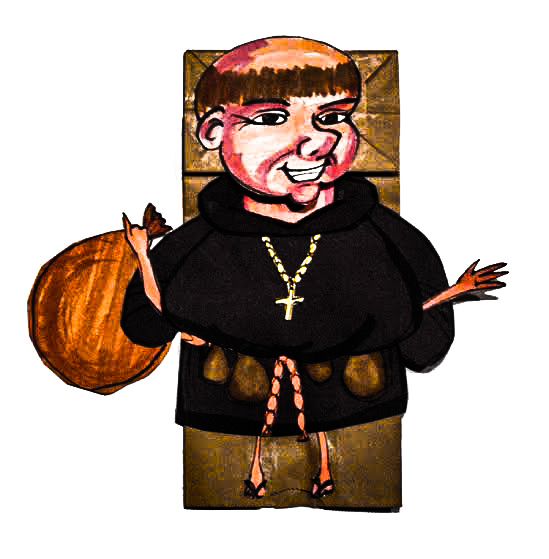
A Frere ther was, a wantowne and a merye, A lymytour, a ful solémpne man. In alle the ordres foure is noon that kan So muchel of daliaunce and fair langage. He hadde maad ful many a mariage Of yonge wommen at his owene cost. Unto his ordre he was a noble post. Ful wel biloved and famulier was he With frankeleyns over al in his contree, And eek with worthy wommen of the toun; For he hadde power of confessioun, As seyde hym-self, moore than a curát, For of his ordre he was licenciat. Ful swetely herde he confessioun, And plesaunt was his absolucioun. He was an esy man to yeve penaunce There as he wiste to have a good pitaunce; For unto a povre ordre for to yive Is signe that a man is wel y-shryve; For, if he yaf, he dorste make avaunt He wiste that a man was répentaunt; For many a man so hard is of his herte He may nat wepe al-thogh hym soore smerte. Therfore in stede of wepynge and preyéres Men moote yeve silver to the povre freres. His typet was ay farsed full of knyves And pynnes, for to yeven faire wyves. And certeinly he hadde a murye note: Wel koude he synge and pleyen on a rote; Of yeddynges he baar outrely the pris. His nekke whit was as the flour-de-lys; Ther-to he strong was as a champioun. He knew the tavernes wel in every toun, And everich hostiler and tappestere Bet than a lazar or a beggestere; For unto swich a worthy man as he Acorded nat, as by his facultee, To have with sike lazars aqueyntaunce; It is nat honest, it may nat avaunce Fór to deelen with no swich poraille, But al with riche and selleres of vitaille. And over-al, ther as profit sholde arise, Curteis he was and lowely of servyse. Ther nas no man nowher so vertuous. He was the beste beggere in his hous; [And yaf a certeyn ferme for the graunt, Noon of his brethren cam ther in his haunt;] For thogh a wydwe hadde noght a sho, So plesaunt was his In principio, Yet wolde he have a ferthyng er he wente: His purchas was wel bettre than his rente. And rage he koude, as it were right a whelpe. In love-dayes ther koude he muchel helpe, For there he was nat lyk a cloysterer With a thredbare cope, as is a povre scolér, But he was lyk a maister, or a pope; Of double worstede was his semycope, That rounded as a belle, out of the presse. Somwhat he lipsed for his wantownesse, To make his Englissh sweete upon his tonge; And in his harpyng, whan that he hadde songe, His eyen twynkled in his heed aryght As doon the sterres in the frosty nyght. This worthy lymytour was cleped Hubérd.
A Frere ther was, a wantowne and a merye,
A lymytour, a ful solémpne man.
In alle the ordres foure is noon that kan
So muchel of daliaunce and fair langage.
He hadde maad ful many a mariage
Of yonge wommen at his owene cost.
Unto his ordre he was a noble post.
Ful wel biloved and famulier was he
With frankeleyns over al in his contree,
And eek with worthy wommen of the toun;
For he hadde power of confessioun,
As seyde hym-self, moore than acurát,
For of his ordre he was licenciat.
Ful swetely herde he confessioun,
And plesaunt was his absolucioun.
He was an esy man to yeve penaunce
There as he wiste to have a good pitaunce;
For unto a povre ordre for to yive
Is signe that a man is wel y-shryve;
For, if he yaf, he dorste make avaunt
He wiste that a man was répentaunt;
For many a man so hard is of his herte
He may nat wepe al-thogh hym soore smerte.
Therfore in stede of wepynge and preyéres
Men moote yeve silver to the povre freres.
His typet was ay farsed full of knyves
And pynnes, for to yeven faire wyves.
And certeinly he hadde a murye note:
Wel koude he synge and pleyen on a rote;
Of yeddynges he baar outrely the pris.
His nekke whit was as the flour-de-lys;
Ther-to he strong was as a champioun.
He knew the tavernes wel in every toun,
And everich hostiler and tappestere
Bet than a lazar or a beggestere;
For unto swich a worthy man as he
Acorded nat, as by his facultee,
To have with sike lazars aqueyntaunce;
It is nat honest, it may nat avaunce
Fór to deelen with no swich poraille,
But al with riche and selleres of vitaille.
And over-al, ther as profit sholde arise,
Curteis he was and lowely of servyse.
Ther nas no man nowher so vertuous.
He was the beste beggere in his hous;
For thogh a wydwe hadde noght a sho,
So plesaunt was his In principio,
Yet wolde he have a ferthyng er he wente:
His purchas was wel bettre than his rente.
And rage he koude, as it were right a whelpe.
In love-dayes ther koude he muchel helpe,
For there he was nat lyk a cloysterer
With a thredbare cope, as is a povre scolér,
But he was lyk a maister, or a pope;
Of double worstede was his semycope,
That rounded as a belle, out of the presse.
Somwhat he lipsed for his wantownesse,
To make his Englissh sweete upon his tonge;
And in his harpyng, whan that he hadde songe,
His eyen twynkled in his heed aryght
As doon the sterres in the frosty nyght.
This worthy lymytour was cleped Hubérd.
Paraphrase in English :
There was also a FRIAR named Hubert, who lived happily and excessively. He was a beggar, but a sweet talking one. Of all the friars in the world, he was the most playful. He was the best beggar in town and was so smooth that he could even get the poorest little old ladies to give him money. As a result, he made more money than he actually needed, which meant that he could play like a puppy all day long. He was good at resolving legal disputes too, and did so wearing thick, bell-shaped robes that were so splendid he looked like the pope instead of a poor friar. He even pretended to have a lisp to make himself sound more dignified. He had married off many young ladies—much to his own dismay. Oh, he was one of the Church’s finest all right! All the guys in town—and the women too—thought he was just great because, as he himself put it, there was no one who could hear confessions better than he could. All you had to do was slip him some change and he’d swear up and down that you were the most penitent person that ever lived, no matter what you’d done or how sorry you really were. And since bribes are easier than actual remorse, this guy had a lot of nice stuff, including a fair amount of jewelry in his robes that he’d use to woo the ladies. He could also play the fiddle and sing the sweetest songs with a twinkle in his eye. He knew all the bars in town and every bartender and barmaid too. He knew them much better, in fact, than he knew any of the lepers or beggarwomen or other poor people whom he was supposed to be helping. It wouldn’t have been fitting for him, the powerful man that he was, to be seen with such people. Besides, there’s no money to be made hanging out with the likes of them. Instead, he’d spend all his time with the wealthy, flattering them so that they would give him money. Nope, no one was more virtuous!

 Classic poetry Daily